No Research without Action , No Action without Research... Kurt Lewin
There are many ways to conduct research. Each of these ways is used in various professional fields, including psychology, sociology, social work, medicine, nursing, education and so on. However, the field of education often uses action research, an interactive method of collecting information that's used to explore topics of teaching, curriculum development and student behavior in the classroom.
Action research is simply a form of self-reflective enquiry undertaken by participants in social situations in order to improve the rationality and justice of their own practices, their understanding of these practices, and the situations in which the practices are carried out (Carr and Kemmis 1986: 162).
Action research is very popular in the field of education because there is always room for improvement when it comes to teaching and educating others. Sure, there are all types of methods of teaching in the classroom, but action research works very well because the cycle offers opportunity for continued reflection. In all professional fields, the goal of action research is to improve processes. Action research is also beneficial in areas of teaching practice that need to be explored or settings in which continued improvement is the focus.
Origin of Action Research
Kurt Lewin is generally credited as the person who coined the term ‘action research’:
The research needed for social practice can best be characterized as research for social management or social engineering. It is a type of action-research, a comparative research on the conditions and effects of various forms of social action, and research leading to social action. Research that produces nothing but books will not suffice (Lewin 1946, reproduced in Lewin 1948: 202-3)
His approach involves a spiral of steps, each of which is composed of a circle of planning, action and fact finding about the result of the action. The basic cycle involves the following

This is how Lewin describes the initial cycle:
The first step then is to examine the idea carefully in the light of the means available. Frequently more fact-finding about the situation is required. If this first period of planning is successful, two items emerge: namely, “an overall plan ” of how to reach the objective and secondly, a decision in regard to the first step of action. Usually this planning has also somewhat modified the original idea.
The next step is ‘composed of a circle of planning, executing, and reconnaissance or fact-finding for the purpose of evaluating the results ofthe second step, and preparing the rational basis for planning the third step, and for perhaps modifying again the overall plan’ . What we can see here is an approach to research that is oriented to problem-solving in social and organizational settings, and that has a form that parallels deweys conception of learning from experience.
The approach, as presented, does take a fairly sequential form – and it is open to a literal interpretation. Following it can lead to practice that is ‘correct’ rather than ‘good’ – as we will see. It can also be argued that the model itself places insufficient emphasis on analysis at key points. Elliot for example, believed that the basic model allows those who use it to assume that the ‘general idea’ can be fixed in advance, ‘that “reconnaissance” is merely fact-finding, and that “implementation” is a fairly straightforward process’. As might be expected there was some questioning as to whether this was ‘real’ research. There were questions around action research’s partisan nature – the fact that it served particular causes.
The decline and rediscovery of action research
Action research did suffer a decline in favour during the 1960s because of its association with radical political activism .There were, and are, questions concerning its rigour, and the training of those undertaking it. However, as Bogdan and Biklen point out, research is a frame of mind – ‘a perspective that people take toward objects and activities’. Once we have satisfied ourselves that the collection of information is systematic and that any interpretations made have a proper regard for satisfying truth claims, then much of the critique aimed at action research disappears. In some of Lewin’s earlier work on actionresearch (e.g. Lewin and Grabbe 1945), there was a tension between providing a rational basis for change through research, and the recognition that individuals are constrained in their ability to change by their cultural and social perceptions, and the systems of which they are a part. Having ‘correct knowledge’ does not of itself lead to change, attention also needs to be paid to the ‘matrix of cultural and psychic forces’ through which the subject is constituted . Subsequently, action research has gained a significant foothold both within the realm of community-based, and participatory action research; and as a form of practice-oriented to the improvement of educative encounters (e.g. Carr and Kemmis 1986).
Undertaking Action research
As Thomas (2017: 154) put it, the central aim is change, ‘and the emphasis is on problem-solving in whatever way is appropriate’. It can be seen as a conversation rather more than a technique (McNiff et. al.). It is about people ‘thinking for themselves and making their own choices, asking themselves what they should do and accepting the consequences of their own actions’ (Thomas 2009: 113).
The action research process works through three basic phases:
Look -building a picture and gathering information. When evaluating we define and describe the problem to be investigated and the context in which it is set. We also describe what all the participants (educators, group members, managers etc.) have been doing.
Think – interpreting and explaining. When evaluating we analyse and interpret the situation. We reflect on what participants have been doing. We look at areas of success and any deficiencies, issues or problems.
Act – resolving issues and problems. In evaluation we judge the worth, effectiveness, appropriateness, and outcomes of those activities. We act to formulate solutions to any problems.
The use of action research to deepen and develop classroom practice has grown into a strong tradition of practice (one of the first examples being the work of Stephen Corey in 1949). For some, there is an insistence that action research must be collaborative and entail groupwork.
Action research is a form of collective self-reflective enquiry undertaken by participants in social situations in order to improve the rationality and justice of their own social or educational practices, as well as their understanding of those practices and the situations in which the practices are carried out… The approach is only action research when it is collaborative, though it is important to realise that action research ofthe group is achieved through the critically examined action of individual group members. Let's take a closer look at the cycle of action research. As you can see, the process first starts with identifying a problem. Then, you must devise a plan and implement the plan. This is the part of the process where the action is taking place. After you implement the plan, you will observe how the process is working or not working. After you've had time to observe the situation, the entire process of action research is reflected upon. Perhaps the whole process will start over again! This is action research!
 |
Methods of Action Research
There are many methods to conducting action research. Some of the methods include:
- Observing individuals or groups
- Using audio and video tape recording
- Using structured or semi-structured interviews
- Taking field notes
- Using analytic memoing
- Using or taking photography
- Distributing surveys or questionnaires
Researchers can also use more than one of the methods above to assist them in collecting rich and meaningful data.
While there are various methods to conducting action research, there are also various types of action research in the fields of education, including individual action research, collaborative action research and school-wide action research. For example:
- Individual action research involves working independently on a project, such as an elementary school teacher conducting her own, in-class research project with her students.
- Collaborative action research involves a group of teachers or researchers working together to explore a problem that might be present beyond a single classroom, perhaps at the departmental level or an entire grade level.
- School-wide action research generally focuses on issues present throughout an entire school or across the district. Teams of staff members would work together using school-wide action research. As you can see, action research can be used in many educational settings.
Benefits of Action Research
Educational action research is a system of inquiry that educators, administrators, and literacy coaches may utilize to ensure progress within schools. Through the action research process, practitioners become knowledgeable about research based instructional strategies to improve pedagogy. There is a myriad of benefits for conducting action research projects within classrooms, buildings or school communities.
The action research process provides educators credibility in their designated disciplines. It allows practitioners the freedom to examine their own teaching as they reflect upon their own instructional strategies to improve best practices. Such an endeavor empowers educators to have a voice in a field that often is encumbered with mandates and top-down directives from state and local policy makers as well as educational managers and administration. Action research allows educators to become creators of their own knowledge about the business of teaching and learning rather than mere consumers of other researchers’ exploration and experience.
Further, the process of integrating action research into a daily regimen stimulates collegiality as it provides an opportunity for teachers to work collaboratively with coaches towards a common goal. Articulating with colleagues regarding instructional strategies, educational modalities, and interpreting and analyzing qualitative/quantitative data promotes intrigue, inquiry, decision making and reflection about teaching. Conducting research studies enables practitioners to be invested in the data collection process. Educators become revitalized while conducting studies where such a goal fosters ingenuity, creativity, problem solving and academic discovery. Practitioners, who are passionate about their own methodology, implement action research studies to evaluate their own work as they reflect upon the importance of making positive change in the classroom. Such an academic goal increases trust, improves communication, and empowers educators to take a stance for real change that benefits both teaching and learning. It is apparent that initiating an action research project motivates educators to make a difference in areas of critical need in any discipline.
Advantages of Action Research:
- High level of practical relevance of the business research;
- Can be used with quantitative, as well as, qualitative data;
- Possibility to gain in-depth knowledge about the problem.
Disadvantages of Action Research
- Difficulties in distinguishing between action and research and ensure the application of both;
- Delays in completion of action research due to a wide range of reasons are not rare occurrences
- Lack of repeatability and rigour
It is important to make a clear distinction between action research and consulting. Specifically, action research is greater than consulting in a way that action research includes both action and research, whereas business activities of consulting are limited action without the research.
Action Research Spiral
Action study is a participatory study consisting of spiral of following self-reflective cycles:
- Planning in order to initiate change
- Implementing the change (acting) and observing the process of implementation and consequences
- Reflecting on processes of change and re-planning
- Acting and observing
- Reflecting
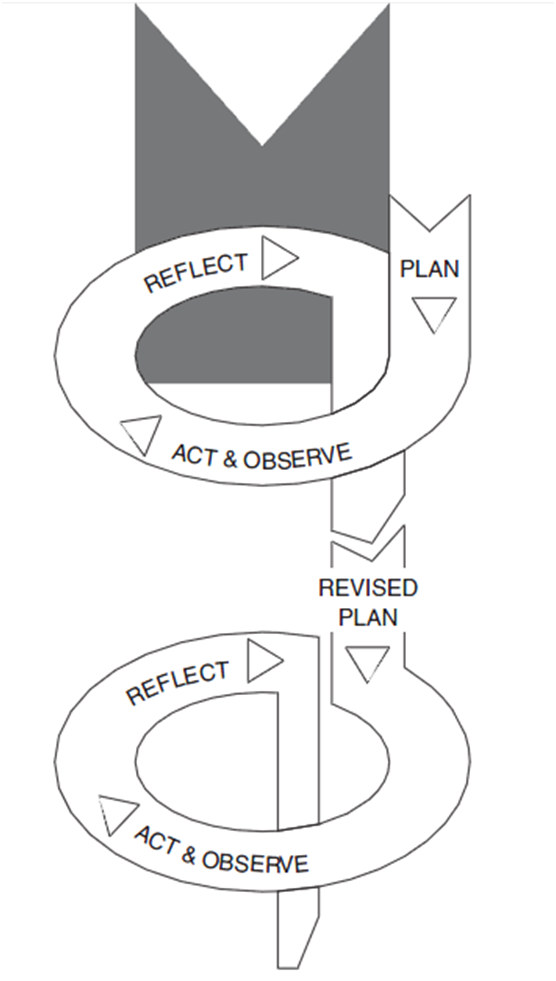
Action Research Spiral
Kemmis and McTaggart (2000) do acknowledge that individual stages specified in Action Research Spiral model may overlap, and initial plan developed for the research may become obselete in short duration of time due to a range of factors.
The main advantage of Action Research Spiral model relates to the opportunity of analysing the phenomenon in a greater depth each time, consequently resulting in grater level of understanding of the problem.
Disadvantages of Action Research Spiral model include its assumption each process takes long time to be completed which may not always be the case.
Example for action research

No comments:
Post a Comment